A pharmacy owner cannot choose between immunity products by counting vitamins on the front panel. You need to verify the product’s legal category, compare its labelled ingredients and commercial terms, screen customers for safety, and test whether it actually sells in your store before committing cash or shelf space.
Key takeaways
- Check whether the product is a food, supplement, nutraceutical or drug.
- Compare per-dose cost, not just the printed price per pack.
- Match the format and dose to the customer’s actual needs.
- Verify the supplier licence, invoice and batch documents before ordering.
Start with the product category and the back-panel label
Before comparing Immufast with another product, identify its regulatory category: food, health supplement, nutraceutical, or drug. The category determines the licence, permitted claims, label declarations, and distribution requirements. “Immunity” or “defence” on the front panel does not make a product an approved medicine.
That is the starting test for immufast vs other immunity products for pharmacies in zirakpur:
1. Check whether the pack shows a valid FSSAI licence number or a drug-manufacturing licence. Ask the supplier for supporting licence details if the number is missing, unclear, or inconsistent with the category.
2. Read the back panel for the product category, every ingredient quantity, serving or tablet strength, recommended daily use, dosage form, net quantity, batch or lot number, expiry or best-before date, and manufacturer or marketer address.
3. Confirm warnings and restrictions, including allergy statements, age limits, pregnancy advice, medicine interactions, and storage instructions. Do not rely on a sales sheet when the pack says something different.
4. Reject disease-prevention or treatment wording that is not permitted for a health supplement or nutraceutical. Pharmacy displays must not turn a general immunity message into claims about preventing COVID-19, influenza, dengue, or another infection.
5. Record the remaining shelf life at delivery and obtain written near-expiry replacement terms. A nominal 24- or 36-month shelf life does not protect you from receiving ageing stock.
Only after these checks should you compare composition, dose, format, price, and supply terms with another product.
Compare labelled composition, dose, format and landed cost
A pharmacy should classify Immufast before comparing it: food, health supplement, nutraceutical or drug. Check the pack for an FSSAI licence number or drug-manufacturing licence; “immunity” and “wellness” are marketing terms, not proof of medicine approval.
| Product | Compare on the label | Commercial checks |
|---|---|---|
| Immufast | Each vitamin, mineral and antioxidant; strength per tablet or serving; recommended dose; tablets, capsules, syrup or powder; pack quantity | MRP, net purchase price, margin, minimum order and remaining shelf life |
| Multivitamin | Amount of every nutrient per daily serving, not the number of ingredients | Avoid paying for overlap when customers already use another multivitamin |
| Vitamin C or zinc | Strength, daily dose and number of doses per pack | Compare cost per recommended daily serving, not cost per tablet |
| Herbal product | Named extracts, plant part, extract ratio and standardisation | Check warnings, allergens, interactions and evidence behind claims |
| Nutrition powder | Nutrients per scoop, scoop size, calories, protein, sugar and serving count | Include measuring effort, storage space and opened-pack wastage |
For Immufast for pharmacy stores, calculate landed cost as purchase price plus freight, taxes or handling, divided by saleable units after expiry risk. A cheaper pack loses its advantage if it arrives with little shelf life remaining, requires special storage or lacks written near-expiry and damage-return terms.
Compare immunity products for pharmacies in Zirakpur using cost per labelled daily serving, remaining shelf life and expected retailer margin. Do not rank products by vitamin count alone; choose the format and dose that fit the customer and the store’s actual selling pattern.
Match the product to the customer, not the immunity claim
A customer’s age, health status, medicines, diet and allergy history determine suitability—not the word “immunity” on the front panel. A healthy adult with a balanced diet and no identified deficiency may not need a supplement at all.
Check these factors before recommending any product:
- Children: use it only when the label gives a suitable age and dose; never assume an adult tablet is safe to split.
- Pregnancy or breastfeeding: refer the customer to a doctor before sale.
- Kidney or liver disease, diabetes, autoimmune disease, or cancer treatment: check with the treating clinician first.
- Existing medicines: review the ingredient list for possible interactions, especially with anticoagulants, thyroid medicines and medicines affected by minerals.
- Food allergies, vegetarian requirements and dietary restrictions: verify excipients, capsule material, sweeteners and allergen declarations.
- A known nutrient deficiency: select a product and dose that address the documented deficiency rather than adding a broad supplement.
| Customer factor | Suitable decision | When to stop or refer |
|---|---|---|
| Age and dose | Match the labelled age range and serving | No age-specific direction or unclear dosing |
| Diet and deficiency | Consider supplementation when intake is poor or deficiency is confirmed | Adequate diet with no identified need |
| Medicines and illness | Check the full composition first | Interaction risk, chronic disease or active treatment |
| Pregnancy or breastfeeding | Obtain clinician advice | Do not recommend casually |
| Allergy history | Confirm every ingredient and excipient | Previous reaction or incomplete label |
Explain that the product supports normal nutritional functions. Do not present it as an antibiotic, antiviral, vaccine, or treatment for influenza, dengue, COVID-19 or another infection.
Test demand and verify the supplying entity before you order
A small, documented pilot is safer than accepting a supplier’s projected demand. Test Immufast in comparable Zirakpur stores and measure weekly units sold, repeat purchases, pharmacist recommendations, stock-outs and packs approaching expiry.
1. Order the smallest practical quantity, not the supplier’s maximum offer. Record opening stock, sales each week and closing stock for four to six weeks. Reorder only when observed sell-through supports the proposed minimum order quantity.
2. Before you buy Immufast for medical store stock, verify the actual Immufast distributor in Zirakpur. Request a tax invoice, GSTIN, batch number, expiry date, licence details and stock location. The GST registration name and address must match the entity issuing the invoice; a WhatsApp quotation or marketplace listing proves nothing.
3. Ask Macro Labs Pvt Ltd to confirm the supplier’s status when the supplier claims to represent the company. Obtain written terms for territory, price, credit period, damaged-pack replacement, expiry returns and promotional stock. PCD franchise language alone does not guarantee exclusivity.
4. Calculate realised gross margin from landed cost, not the advertised trade margin. Include freight, GST treatment, retailer discounts, free or promotional units, credit cost, expiry write-offs and inventory tied up by the minimum order.
If Immufast is classified as a drug, confirm that your medical store’s drug-sale licence, records and supervision meet the applicable retail requirements.
Compare the pilot’s net return and repeat rate with competing multivitamins, vitamin C, zinc, herbal products and nutrition powders. Keep the product only if it sells without heavy discounting and leaves acceptable margin after losses.
Related product
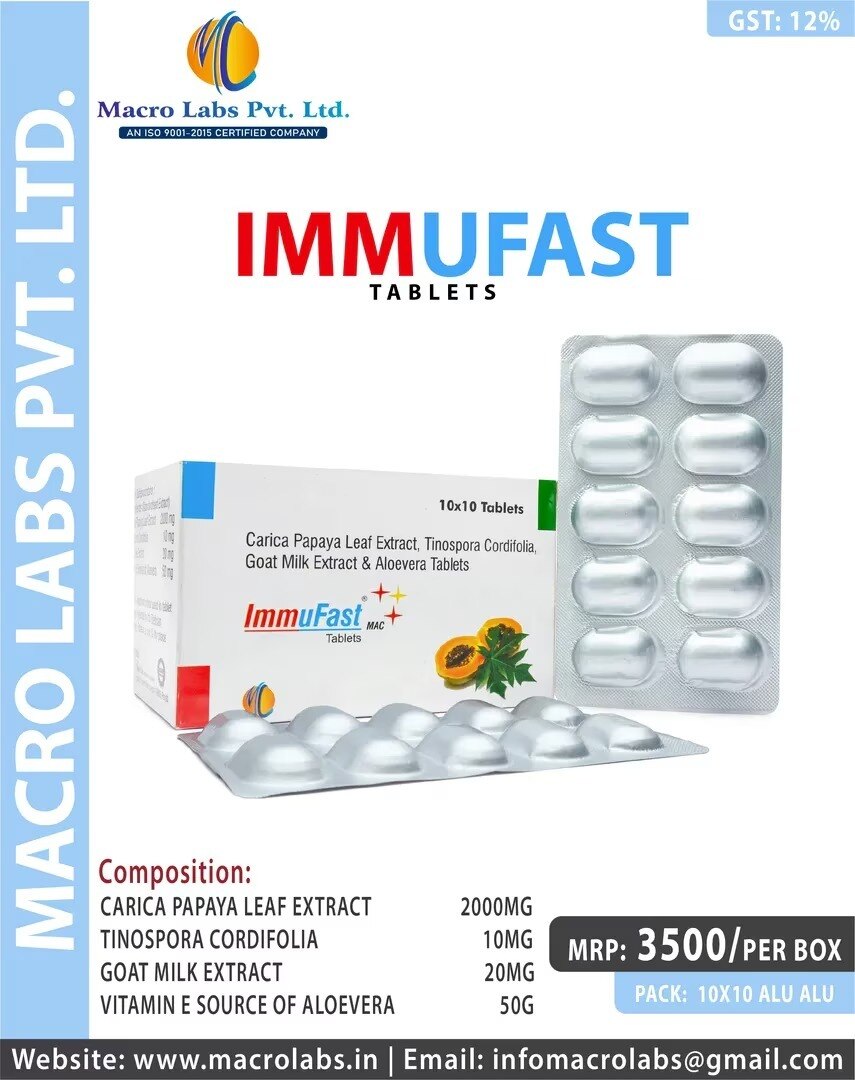
 | Immufast Immufast by Macro Labs Pvt. Ltd. is a scientifically formulated health supplement designed to strengthen immunity and enhance overall wellness. |
Give accurate advice and set a measurable product decision rule
Do not call Immufast a medicine because its pack says “immunity” or “defence.” First identify the category: check for an FSSAI licence number if it is a food, health supplement or nutraceutical, or a drug-manufacturing licence and approved indication if it is a medicine. Explain only the labelled purpose, dose and usage.
Say that it supports normal nutritional function; it does not prevent, treat or cure infection, replace a vaccine, or act as an antibiotic or antiviral.
| Choice | Explain it as | Choose it when |
|---|---|---|
| Immufast | A labelled supplement with its stated ingredients and serving | The licence, composition, dose, storage and shelf life meet your rule |
| Another supplement | A competing formula, not automatically a better one | Its active amount, format, price per daily serving or customer fit is superior |
| Clinical referral | Advice beyond supplement selection | The customer has concerning symptoms, pregnancy, chronic disease, medicine interactions or allergy risk |
Use a written pilot rule before accepting a large order:
- Test in three comparable Zirakpur stores for four weeks; record weekly sales, recommendation-to-purchase rate, repeat buyers, stock-outs and expiry risk.
- Reorder only if at least 60% of opening units sell, at least 20% of recorded buyers repeat within 30 days, and no more than 5% of units reach damage or expiry loss.
- Choose a competitor if it wins on the same measures or arrives with better remaining shelf life and written near-expiry replacement terms.
- Refer customers with breathing difficulty, dehydration, persistent high fever or suspected infection instead of recommending any immunity product.
Frequently asked questions
What should Zirakpur pharmacies check first when comparing Immufast?
Read the back-panel label to identify whether Immufast is a food, health supplement, nutraceutical or drug. Check the category, licence details, ingredients, dose, warnings, batch number and manufacturer or marketer information.
How can a pharmacy compare Immufast with other immunity products?
Compare the labelled composition, serving size, dosage form, pack quantity, expiry period and landed cost per dose. Include freight, taxes, discounts and damaged-stock risk in the landed-cost calculation.
How should pharmacies choose immunity products for customers?
Match the product to the customer’s age, dosage preferences, dietary restrictions, budget and reason for purchase. Do not treat a front-panel immunity claim as proof that the product treats or prevents disease.
What should pharmacies verify before ordering Immufast?
Ask the supplier for the supplying entity’s licence details, GST invoice, manufacturer or marketer information, batch documentation, expiry details and return terms. Test demand with a small opening order and track sales by pack and repeat purchase.
Keywords